
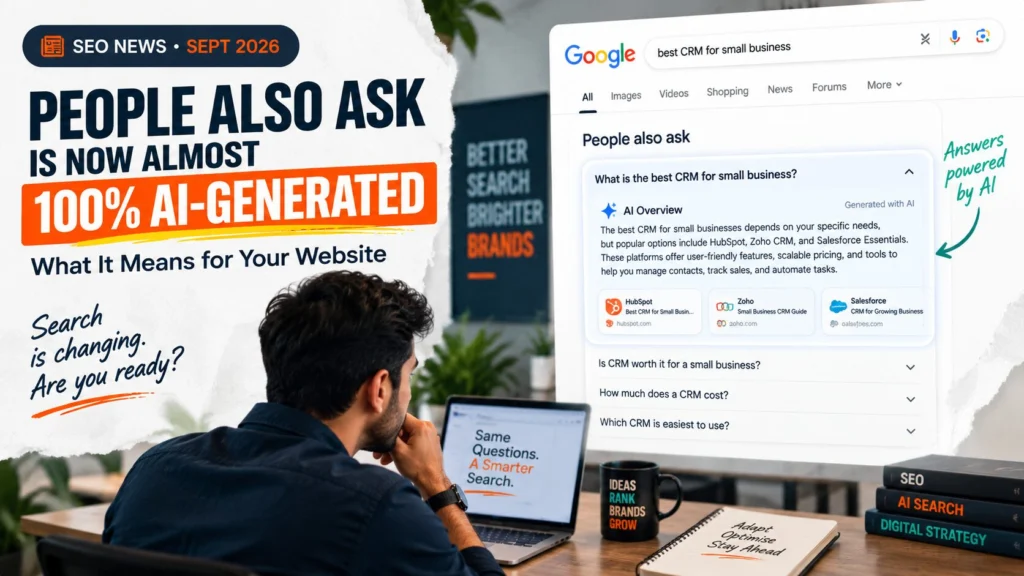

If you’ve ever tried to rank in Google’s “People Also Ask” box, here’s some news: that box barely sends traffic to websites anymore. Google is now writing almost all of those answers itself, using AI.
What happened
Two independent SEO data providers checked this in September 2026 and landed on nearly the same number. AlsoAsked looked at 19.2 million English-language “People Also Ask” results and found that 97% of the answers in the first week of September were written by AI — up from 86% in August, and just 12% fourteen months ago. A second tool, Allintitle’s Also Ask Miner, put the figure at a flat 100% since August.
Google hasn’t confirmed the exact number itself, but the trend lines up with what most SEOs have been watching for over a year: AI Overviews are steadily taking over spots that used to link straight to a website.
Why it matters for your business
“People Also Ask” boxes used to be a real source of traffic. If your page had the clearest, most complete answer to a question, Google would often quote it, put your site’s name next to the quote, and readers would click through to see the rest. That was a low-effort way for a Navi Mumbai or Mumbai business to get in front of new customers, especially for the kind of practical, question-based searches people run before they call a shop, a clinic, or a service provider.
That pathway is closing. When Google writes the answer itself, there’s often nothing to click. We’ve already flagged this shift in how AI Overviews are changing click behaviour — this new data just shows how fast it’s moving specifically inside the “People Also Ask” box, which used to be one of the more reliable places to earn a click.
What to do about it
The goal now isn’t “win the People Also Ask box.” It’s “become the source Google’s AI trusts enough to name.” A few practical changes:
- Answer the question in the first two sentences. Don’t bury the direct answer under a long introduction — AI systems tend to pull from the clearest, most upfront answer on the page.
- Use real, specific detail. Prices, timelines, local context, and named examples are harder for an AI to paraphrase away than generic advice — and more likely to get you cited by name.
- Structure your page around the actual question. A heading that matches how people search (“How much does website design cost in Navi Mumbai?”) gives both Google and readers a clean answer to point to.
- Track citations, not just rankings. A high ranking with no click is now a common outcome. If you can, check whether your business is being named inside AI Overviews for your key questions — that’s becoming a better signal of visibility than position alone.
None of this replaces solid local SEO fundamentals — a strong Navi Mumbai search presence still matters for the searches that lead to a call or a visit. But for the informational, question-style searches that used to feed the “People Also Ask” box, the win condition has quietly changed from ranking to being quoted.