
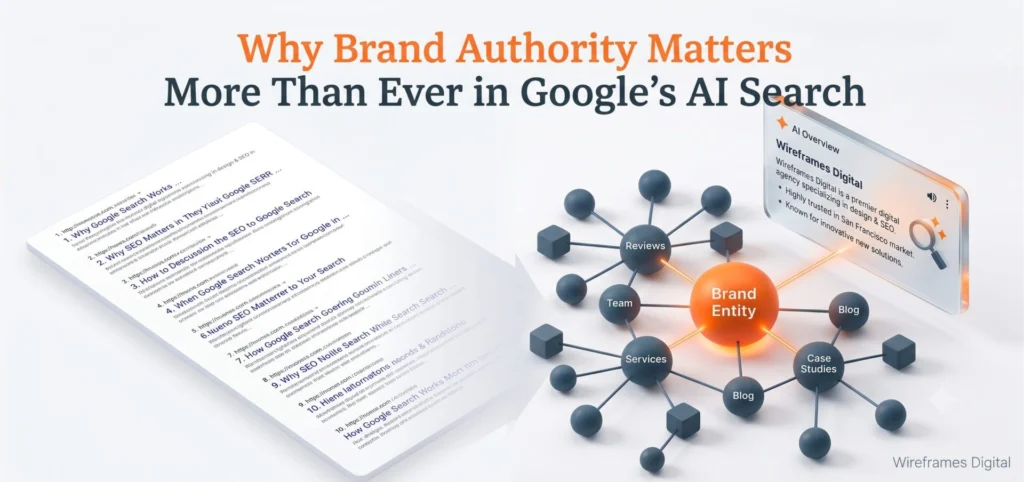

Google Search is no longer only a list of ranked pages. AI Overviews and AI Mode can synthesize information before a searcher decides which result to visit, changing the relationship between visibility, clicks, and conversions.
That makes one question increasingly important for SEO teams: if a page is visible inside an AI-generated answer but does not receive a click, is that SEO success?
The answer is more complicated than a simple yes or no. A new research paper published on August 5, 2026, examined browsing behavior around Google AI Overviews and found that visits to sources cited inside AI Overviews were rare in the study sample. Google has also introduced a dedicated Generative AI performance report in Search Console, giving eligible site owners a first-party way to monitor impressions from AI Overviews and AI Mode.
For businesses, this changes what should be measured. Rankings still matter, but they are no longer enough. AI visibility, qualified traffic, branded demand, conversions, and the pages that repeatedly earn visibility across search journeys need to be considered together.
What changed in Google Search?
Google’s AI Search experience is built into the search journey rather than existing as a completely separate product. AI Overviews can appear above traditional results, while AI Mode is designed for more conversational and exploratory searches.
Google’s own documentation says its generative AI features are grounded in its core Search systems. In other words, SEO has not been replaced by a secret AEO ranking system. Google explicitly says that SEO best practices remain relevant because its AI experiences use Search’s ranking and quality systems to retrieve useful web pages.
That distinction matters. Businesses should not abandon crawling, indexing, information architecture, internal linking, content quality, structured data, or technical SEO because the search interface has changed.
New research raises a harder question: visibility does not always mean traffic
A study published on August 5, 2026, examined one month of browsing behavior from a representative panel of 900 U.S. adults. The researchers found that when AI Overviews appeared, clicks to sources cited within those AI Overviews were rare, occurring in about 1% of visits to AI Overviews in the study.
The same research associated AI Overviews with fewer clicks and higher rates of ending browsing sessions. It also found that longer and question-style queries were among the attributes associated with AI Overview appearance.
This does not mean that every AI Overview produces a 1% click rate, nor does it establish a universal click-through rate for every website or query. It is one study using a defined sample and methodology. But it provides an important signal: being cited inside an AI answer and receiving a website visit are different outcomes.
Source: Investigating Click Behaviors On Google Search Result Pages That Produce an AI Overview.
Google has also changed how SEOs can measure AI visibility
On June 3, 2026, Google announced new Search Console Generative AI performance reports. The Search report provides a dedicated view of impressions from generative AI features such as AI Overviews and AI Mode. Google says the reports can be segmented by pages, countries, devices, and dates.
There is an important limitation: the report is still being rolled out to a subset of properties. Google also describes the metric primarily in terms of impressions and visibility, rather than giving SEOs a complete picture of clicks or conversions generated by AI features.
That makes the report useful, but not sufficient by itself.
Source: Google Search Central: Introducing Search Generative AI performance reports in Search Console.
What the new Search Console report actually tells you
| Signal | What it tells you | What it does not tell you |
|---|---|---|
| AI impressions | How often your URLs appeared in supported generative AI features | Whether the user clicked or converted |
| Pages | Which URLs are receiving AI visibility | Why Google selected each URL |
| Country | Where AI visibility is occurring | Full customer intent |
| Device | Which devices are associated with Search AI impressions | Revenue impact |
| Date | How AI visibility changes over time | Causal attribution by itself |
This creates an opportunity for SEO teams to establish an AI visibility baseline. Instead of asking only, “What keywords are ranking?”, teams can also ask, “Which pages are repeatedly being surfaced in Google’s generative experiences, and what business outcomes do those pages influence?”
Why rankings still matter
It is tempting to interpret AI Search as a replacement for traditional rankings. Google’s own documentation argues against that interpretation.
Google’s guide for optimizing websites for generative AI features states that SEO remains relevant because generative AI features rely on core Search ranking and quality systems. Its guidance emphasizes valuable, unique, non-commodity content and continues to recommend established SEO fundamentals.
Source: Google Search: Optimizing your website for generative AI features.
This is why AEO and GEO should be treated as extensions of a strong SEO program rather than replacements for it.
The real shift: from ranking pages to building useful search assets
Traditional SEO often encourages teams to think in terms of individual keywords and individual rankings. AI Search makes that model less complete.
A user may begin with a broad question, ask a follow-up, compare options, look for local providers, and then search for a specific brand. Across that journey, Google can draw from multiple pages and sources.
The strategic objective should therefore become broader:
- Build strong topical coverage around the problems your customers actually research.
- Create pages that answer specific questions clearly and completely.
- Demonstrate first-hand experience and credible expertise.
- Make your business, products, services, locations, and authors easy to understand.
- Connect related pages with logical internal links.
- Maintain technically sound, crawlable, indexable websites.
- Measure AI visibility alongside conventional organic performance.
Topical authority becomes more important
One strong article rarely establishes a business as the best source for an entire subject. A connected body of useful content can be much more powerful.
For example, an SEO agency targeting Mumbai should not publish only a page titled “SEO Company in Mumbai.” It can build supporting content around local SEO, technical SEO, SEO pricing, Google Search Console, industry-specific SEO, SEO versus Google Ads, website migrations, case studies, and AI Search Optimization.
Those pages should not exist as isolated articles. They should form an architecture.
Wireframes Digital’s approach is built around exactly this model: money pages supported by related content clusters and descriptive internal links. For example, this article can naturally support the SEO company in Mumbai page, the SEO company in Navi Mumbai page, and relevant technical and local SEO resources.
What businesses should measure in 2026
A modern SEO dashboard should not collapse everything into one traffic number.
1. Traditional organic visibility
Continue monitoring impressions, clicks, CTR, rankings, landing pages, and non-branded query growth in Search Console.
2. Generative AI visibility
Where the new Search Console report is available, establish a baseline for AI impressions and identify which pages are receiving visibility in AI Overviews and AI Mode.
3. Branded demand
Track whether people are searching for your company, products, experts, and distinctive content more frequently. Brand demand can be an important secondary indicator of visibility when users encounter a business before visiting its website.
4. Qualified traffic
A decline in total informational clicks does not automatically mean SEO is failing. If fewer visitors arrive but a greater share becomes qualified leads or customers, the business outcome may improve.
5. Conversions and revenue
Ultimately, SEO exists to support business outcomes. Leads, sales, calls, appointments, sign-ups, and revenue should remain connected to the organic strategy.
Technical SEO still has a job to do
AI Search does not remove the need for technically accessible websites.
Google’s documentation continues to emphasize the fundamentals that allow Search systems to discover, understand, and retrieve web content. That means SEO teams should continue to audit:
- Crawlability and indexability
- Canonicalization
- Internal linking
- Rendering and JavaScript dependencies
- Structured data where appropriate
- Page experience and Core Web Vitals
- Clear headings and content hierarchy
- Duplicate and thin content
- Image, video, and other supporting content formats
Google’s July documentation updates also included clarification around canonicalization troubleshooting and new guidance for evaluating third-party SEO tools and services. These updates reinforce a broader point: technical precision and good SEO judgment still matter even as the search interface changes.
Don’t chase fake AEO or GEO hacks
The growth of AI Search has created a market for questionable optimization claims: special phrases that supposedly force an AI model to cite a company, hidden text designed for language models, manufactured mentions across communities, and other shortcuts.
Google’s own generative AI guidance specifically addresses common misconceptions around AEO and GEO. The safer strategy is not to search for a secret prompt or markup trick. Build content that is genuinely useful, technically accessible, specific, and supported by evidence.
That also means avoiding AI-generated content at scale when it produces generic pages with little original value. AI can accelerate research, analysis, outlining, and production workflows, but the finished content still needs editorial judgment and a reason to exist.
A practical AI Search optimization framework
| Layer | Action |
|---|---|
| Technical | Make important pages crawlable, indexable, fast, and logically connected. |
| Content | Answer real customer questions with original, useful information. |
| Entity | Clearly define who the business is, what it offers, where it operates, and who its experts are. |
| Authority | Build credible references, case studies, expert contributions, and relevant mentions. |
| Local | Maintain accurate location information and create genuinely useful local content. |
| Measurement | Track conventional Search performance and AI visibility separately, then connect both to business outcomes. |
What this means for SEO agencies
The agency conversation is changing from “How many keywords did we rank?” to a much broader question: “How much demand are we capturing across the evolving search journey?”
That does not make keyword rankings irrelevant. It makes them one layer of a larger measurement system.
For an agency, this creates a stronger reporting model:
- Search visibility
- Non-branded growth
- AI Search visibility
- Top-performing content clusters
- Brand demand
- Qualified leads
- Conversion rate
- Revenue influenced by organic search
This is also where SEO and conversion optimization become inseparable. If AI Search increasingly answers informational questions before a click happens, the pages that do receive visits need to be exceptionally good at converting intent into action.
Wireframes Digital’s recommendation for 2026
Do not rebuild your SEO strategy around AI Search. Extend it.
Start with technically strong websites and useful content. Build topical depth around commercial subjects. Strengthen internal linking. Publish original case studies and first-hand insights. Make local and entity information consistent. Then use the new Search Console AI reporting as another measurement layer.
For businesses in Mumbai and Navi Mumbai, that means building a search architecture rather than publishing disconnected blog posts. Your commercial pages should be supported by educational resources, local content, technical guides, comparisons, case studies, and evidence that demonstrates expertise.
For example, businesses evaluating an SEO partner can start with our guide on how to choose an SEO company in Mumbai. Businesses comparing channels can also review SEO vs Google Ads in Navi Mumbai.
Frequently Asked Questions
Does AI Search mean SEO is dead?
No. Google explicitly states that SEO best practices remain relevant to its generative AI Search experiences because those systems are grounded in core Search ranking and quality systems.
Do AI Overviews reduce clicks?
Some research indicates that AI Overviews can be associated with fewer clicks. A study published August 5, 2026, found that clicks to cited sources were rare in its sample. The result should be treated as research evidence rather than a universal CTR benchmark.
Can I track AI Search visibility in Google Search Console?
Google launched a Generative AI performance report in June 2026. It provides impressions and page-level visibility for AI Overviews and AI Mode, but access is still being rolled out and the report does not provide a complete conversion picture.
Should I optimize separately for AEO and GEO?
Use AEO and GEO as useful frameworks, but do not abandon core SEO. Google’s own guidance emphasizes that established SEO practices remain foundational for generative AI features.
What should I do if my traffic drops while AI impressions increase?
Do not immediately assume the strategy is failing. Compare AI visibility, organic clicks, branded demand, landing-page engagement, leads, and revenue. Determine which parts of the search journey are changing and which pages are still generating commercial value.
Final takeaway
Google AI Search is changing how people consume search results, but it is not making the fundamentals of SEO obsolete.
The biggest change is measurement. Visibility inside an AI answer is not the same thing as a website visit. A ranking is not the same thing as a qualified lead. And traffic is not the same thing as revenue.
The businesses best positioned for the next stage of Search will be the ones that build strong technical foundations, develop genuine topical authority, create original content, strengthen their entities, and measure visibility across both traditional and generative search experiences.
SEO is not disappearing. The definition of search visibility is getting bigger.
Sources
- Investigating Click Behaviors On Google Search Result Pages That Produce an AI Overview — published August 5, 2026.
- Google Search Central: Introducing Search Generative AI performance reports in Search Console — June 3, 2026.
- Google Search Console Help: Generative AI performance report.
- Google Search: Optimizing your website for generative AI features.
- Google Search Central: A new resource for optimizing for generative AI in Search — May 15, 2026.