
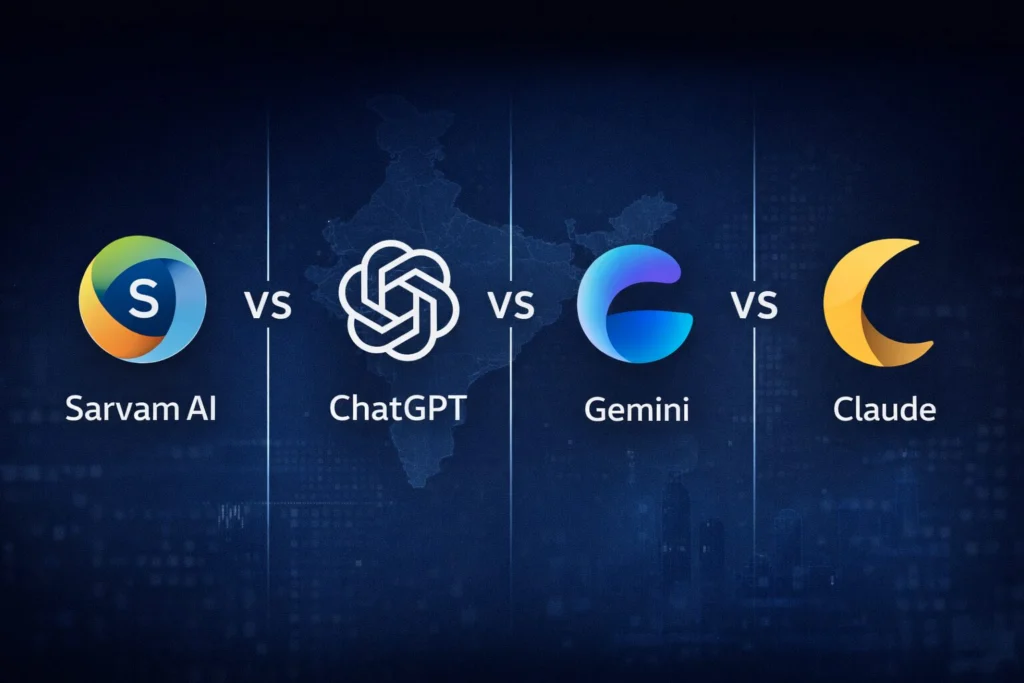

If you’re running a business or agency in India, you’ve probably already tried at least one AI tool. Maybe ChatGPT for content. Gemini for quick research. Claude for long-form writing. And recently, Sarvam AI has started popping up in conversations, especially among people who care about Indian languages and local context.
The obvious question is coming up more often now: which AI is actually useful for SEO and digital marketing in India?
Not which one sounds impressive.
Not which one demos well on Twitter.
But which one helps you get work done. Content, SEO, ads, strategy, execution.
Because here’s the thing. Most AI comparisons you read online are written from a US or Europe point of view. Indian businesses don’t operate the same way. Budgets are tighter. Languages are mixed. Local intent matters more. And Google India behaves very differently.
So let’s break this down properly.
Why This Comparison Matters for Indian Businesses
AI is no longer optional in digital marketing. It’s already baked into how agencies work, whether they admit it or not.
But in India, AI needs to handle:
- Hinglish, not just clean English
- Regional languages, not just Hindi
- Local search intent (Mumbai, Navi Mumbai, Bangalore, Tier-2 cities)
- Pricing-sensitive audiences
- High competition with low patience
A tool that writes beautiful English paragraphs but doesn’t understand Indian search behavior isn’t very useful in practice.
That’s where the real differences start showing.
The Major AI Players in This Space (As of 2026)
Let’s be clear about the tools most Indian marketers are actually using.
- ChatGPT (OpenAI)
- Gemini (Google)
- Claude (Anthropic)
- Sarvam AI (India-focused)
- Perplexity AI
- Meta AI (LLaMA-based tools)
- Jasper (still used by some agencies)
- Copy.ai (less popular now, but still around)
For this blog, we’ll focus on the ones that matter most right now.
ChatGPT: The Swiss Army Knife for Marketers
ChatGPT is still the most widely used AI tool in India. And for good reason.
It’s flexible.
It’s fast.
And with the right prompts, it’s powerful.
Where ChatGPT Works Well for SEO
For Indian SEO professionals, ChatGPT is excellent for:
- Content outlines and first drafts
- Meta titles and descriptions
- Blog ideation
- Keyword clustering logic
- Explaining SEO concepts to clients
A lot of agencies quietly use it as a productivity layer on top of their SEO services. It doesn’t replace thinking, but it speeds things up.
Where ChatGPT Falls Short in the Indian Context
Here’s the honest part.
ChatGPT doesn’t naturally understand:
- Indian local search behavior
- Regional language nuance
- How Indian users phrase queries
- Pricing sensitivity in Indian markets
You can force it with prompts. But that requires experience.
For example, content that sounds fine globally often feels slightly off to Indian readers. Too polished. Too generic. Too “international”.
That’s where tools like Sarvam are trying to play.
Gemini: Strong Research, Weak Execution
Gemini has one big advantage. It’s deeply connected to Google’s ecosystem.
For research-heavy tasks, Gemini is useful:
- Quick summaries
- Fact checks
- Understanding broad topics
- Exploring trends
For SEO professionals, it helps when working with:
- Search behavior insights
- Topic research
- Google-first thinking
The Problem With Gemini for SEO Content
Gemini struggles with:
- Writing natural, conversion-focused content
- Long-form SEO blogs
- Indian tone and language mix
- Marketing copy that sounds human
It’s good at explaining things. Not great at selling or persuading.
Most agencies use Gemini as a research assistant, not a content engine.
Claude: Best for Long-Form Writing, Not Strategy
Claude has built a reputation for handling long documents well.
For content teams, Claude is useful for:
- Long blog drafts
- Whitepapers
- Policy-heavy content
- Structured explanations
It tends to sound calmer and more neutral than ChatGPT.
Where Claude Doesn’t Fit Indian SEO Perfectly
Claude is:
- Less flexible with prompts
- Less tuned for marketing language
- Not India-aware by default
For Indian SEO, content still needs local flavor. Claude’s output often feels safe, but slightly distant. That matters when you’re writing for Indian business owners, not global audiences.
Sarvam AI: Built for India, Finally
Sarvam AI is different. Not because it’s “better” at everything. But because it’s built with Indian use cases in mind.
This matters more than people realize.
What Sarvam AI Gets Right
Sarvam’s biggest strength is language and context.
It understands:
- Indian languages
- Mixed-language usage
- Regional phrasing
- Cultural nuance
For SEO and digital marketing in India, this opens up real opportunities.
Think about:
- Local SEO content in regional languages
- Google Business Profile descriptions for non-English audiences
- Voice search optimization in Indian languages
- Customer support content
- Ad copy for regional campaigns
This is where Sarvam can genuinely help Indian businesses compete better.
Sarvam AI for SEO in India: Practical Use Cases
Let’s get specific. No hype.
1. Regional Content for Local SEO
Most local SEO campaigns in India are still English-only. That’s a missed opportunity.
Sarvam can help generate:
- Local landing pages in regional languages
- Hinglish content that sounds natural
- Service descriptions that connect better with local users
When combined with proper local SEO services, this becomes powerful.
2. Voice Search and Conversational Queries
Voice search in India often happens in:
- Hindi
- Tamil
- Telugu
- Mixed English + local language
Sarvam’s language focus makes it better suited for this compared to global tools.
This will matter more in 2026–2028 as voice-driven queries increase.
3. Customer Communication and CRM Content
SEO doesn’t stop at rankings.
Sarvam can support:
- Chat responses
- WhatsApp automation scripts
- Support content
- FAQ generation in Indian languages
That improves engagement signals, which indirectly supports SEO.
AI Alone Won’t Rank You on Google
This needs to be said clearly.
No AI tool will:
- Build authority for you
- Earn backlinks
- Understand your business deeply
- Decide what not to publish
AI supports SEO. It doesn’t replace it.
That’s why serious businesses still rely on structured SEO services instead of tool-only approaches.
AI + SEO Services: The Real Winning Combination
The best SEO setups in India right now combine:
- Human strategy
- AI-assisted execution
- Clear intent mapping
- Strong internal linking
- Long-term consistency
AI speeds up work. Experience decides direction.
This applies whether you’re doing:
- Local SEO
- Ecommerce SEO
- Enterprise SEO
- Content-driven SEO
Without strategy, AI just helps you make mistakes faster.
So Which AI Should Indian Marketers Use?
Here’s the honest answer.
Most teams will use more than one.
- ChatGPT for flexibility and ideation
- Gemini for research and Google alignment
- Claude for structured long-form drafts
- Sarvam AI for Indian language and local context
The mistake is trying to force one tool to do everything.
The Bigger Picture for 2026, 2027, 2028
AI will continue improving. But Google will continue filtering.
What will matter more over time:
- Topical authority
- Trust
- Local relevance
- Consistency
AI that understands India will help. But only if it’s used inside a proper SEO framework.
That’s where agencies that understand both automation and SEO fundamentals will pull ahead.
If you’re planning SEO and digital marketing seriously for the coming years, tools matter. But strategy matters more. And that’s where experienced teams like Wireframes Digital focus their work. Using AI where it helps. Ignoring it where it doesn’t.
FAQs
Is Sarvam AI better than ChatGPT for Indian SEO?
For Indian language and local context, yes. For general SEO tasks, ChatGPT is still more versatile.
Can AI tools replace SEO agencies?
No. They replace tasks, not strategy or experience.
Which AI is best for content writing in India?
ChatGPT for flexibility, Claude for long-form, Sarvam for regional and local content.
Will Google penalize AI-written content?
Google doesn’t penalize AI content. It penalizes low-quality content without value.
Should small Indian businesses use AI for SEO?
Yes, but only with guidance. Blind automation often backfires.