

If you’re running a business in Mumbai, Navi Mumbai, or even Bangalore, you’ve probably heard this question more than once: does SEO even have a future anymore?
Between AI tools writing content in seconds, Google changing search layouts every few months, and automation creeping into everything, the doubt feels valid. You see AI summaries replacing clicks. You see ads everywhere. And you wonder if SEO is slowly dying.
Here’s the honest answer from someone who’s been doing SEO in India long enough to see multiple “SEO is dead” cycles come and go: SEO isn’t disappearing. But the version most people are still doing absolutely will.
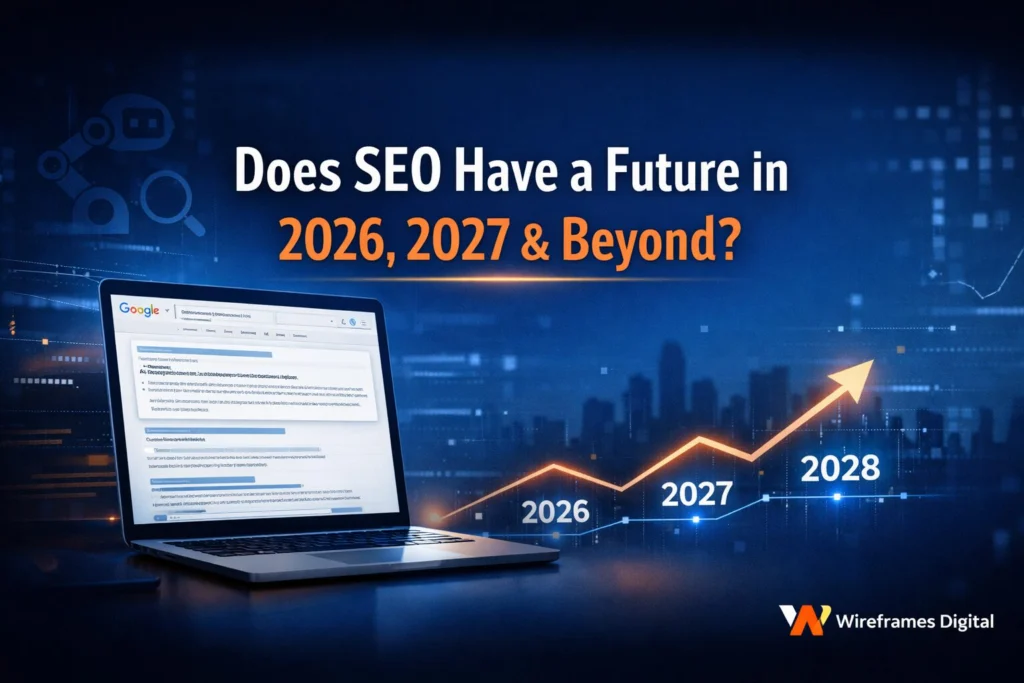
The next three years. 2026, 2027, and 2028. Will separate businesses that understand how search actually works from those still chasing outdated tricks. If you’re relying on blog volume, cheap backlinks, or surface-level optimization, you’re already late.
Let’s talk about what’s really happening. And more importantly, what SEO looks like going forward for Indian businesses.
Why People Think SEO Has No Future Anymore
This fear didn’t come out of nowhere.
In the last two years alone, business owners have seen:
- AI-generated answers on Google pushing organic listings down
- Zero-click searches increasing
- Tools promising “fully automated SEO”
- Content saturation like never before
And yes, some SEO traffic has dropped. Especially for generic, informational content.
But here’s what most people miss.
SEO was never just about traffic.
It was about visibility at the moment of intent.
That hasn’t gone away. It’s become stricter.
SEO in India Has Always Been About Adaptation
If you’ve done SEO in Mumbai, you already know one thing: what works in the US rarely works here the same way.
Indian SEO has always been:
- More competitive
- More price-sensitive
- More aggressive with shortcuts
Every major Google update wipes out a chunk of agencies and freelancers. The rest adapt.
That’s exactly what’s happening again. Only this time, automation and AI are accelerating the gap.
What Automation Actually Means for SEO (Not the Hype Version)
Automation in SEO isn’t new. We’ve been automating parts of SEO for years.
What’s changed is who can automate and what gets automated.
By 2026, automation will comfortably handle:
- Basic keyword clustering
- Content briefs
- Internal linking suggestions
- Technical issue detection
- Reporting and dashboards
Tools already do this. Better tools will do it faster.
But here’s the part AI still struggles with.
Automation doesn’t understand business context.
It doesn’t know:
- Why a Mumbai-based service business converts differently from a Bangalore SaaS
- Why ranking for a keyword doesn’t always mean revenue
- Why certain pages shouldn’t be optimized aggressively
- Why some content should never be scaled
That judgment still matters. And it will matter more as automation increases.
SEO in 2026: The End of Mechanical SEO
By 2026, mechanical SEO is done.
This includes:
- Publishing content just because a tool says “high volume”
- Creating multiple location pages with swapped city names
- Relying on generic backlinks
- Optimizing pages without understanding intent
Google already filters this. It will get harsher.
SEO in 2026 becomes more selective.
Fewer pages. Better pages. Clear purpose.
This is where SEO services that understand structure and intent outperform those chasing scale. It’s also why businesses investing in proper SEO foundations still see results while others complain that SEO “doesn’t work anymore”.
If you’re serious about longevity, working with structured SEO services instead of ad-hoc fixes makes a visible difference. That’s exactly why businesses still invest in professional SEO services instead of tool-only setups.
SEO in 2027: Authority Beats Volume
2027 is where the gap becomes obvious.
By then:
- AI content floods the internet
- Average content becomes worthless
- Google relies more on authority signals than freshness
Authority doesn’t mean brand size alone.
It means consistency and credibility over time.
Websites that win in 2027 will:
- Have fewer but stronger pages
- Be referenced across their niche
- Show clear topical focus
- Avoid chasing every keyword trend
This is where local SEO becomes more powerful, not less.
A business with strong Google Business Profile signals, location relevance, and service clarity will outperform national content farms every time. That’s why local SEO services remain one of the safest SEO investments for Indian businesses.
Mumbai search results already show this pattern.
SEO in 2028: Search Becomes Intent-Driven, Not Keyword-Driven
By 2028, search won’t be about keywords in the traditional sense.
It will be about:
- Who solves the user’s problem best
- Who is trusted in that category
- Who consistently satisfies search intent
SEO will look less like optimization and more like positioning.
Pages that exist only to rank will disappear.
Pages that exist to answer, convert, and retain will survive.
This is where businesses combining SEO with strong website foundations win. A poorly built site, slow UX, or confusing structure won’t survive. That’s why SEO and website development can’t be treated separately anymore.
Does SEO Still Make Sense for Indian Businesses?
Short answer. Yes.
Long answer. Only if you’re doing the right kind of SEO.
SEO still works because:
- Search intent hasn’t gone away
- People still compare, evaluate, and decide on Google
- Paid ads alone don’t build trust
- AI summaries still pull from authoritative sources
But SEO won’t tolerate laziness.
This is especially true for:
- Ecommerce brands competing on margins
- Service businesses in Mumbai and Navi Mumbai
- B2B companies with long sales cycles
- Enterprises managing thousands of pages
Each of these needs a different SEO approach. Ecommerce SEO, enterprise SEO, and local SEO are no longer interchangeable strategies. Treating them the same is one of the biggest mistakes Indian businesses make.
Common SEO Mistakes That Will Kill Growth After 2026
Let’s be blunt.
These mistakes won’t survive the next few years:
- Publishing blogs without a clear purpose
- Ignoring internal linking
- Relying on AI content without human oversight
- Chasing every Google update emotionally
- Expecting SEO to work without patience
And one big one.
Thinking SEO is a one-time activity.
It never was.
Where Automation Helps (And Where It Doesn’t)
Automation will help you:
- Scale research
- Monitor issues
- Improve efficiency
- Reduce manual work
Automation will not:
- Build trust
- Understand your customers
- Decide what not to publish
- Protect you from bad strategy
That’s the line businesses need to understand.
This is why SEO agencies that combine automation with experience will thrive, while tool-only approaches hit a ceiling.
So, Does SEO Have a Future?
Yes. But not the SEO most people are comfortable with.
SEO’s future is:
- Smaller in volume
- Stronger in impact
- Tied closely to business goals
- Integrated with content, UX, and trust
If you’re asking this question today, it’s actually a good sign. It means you’re thinking beyond hacks.
The businesses that win in 2026, 2027, and 2028 won’t ask whether SEO has a future. They’ll be too busy benefiting from it.
And if you’re serious about building SEO that survives automation, algorithm updates, and market shifts, that’s exactly the kind of work Wireframes Digital focuses on. Not quick wins. Not hype. Just sustainable growth that still makes sense years from now.
FAQs
Does SEO still work in India with AI tools everywhere?
Yes. AI hasn’t removed search intent. It’s raised the bar for quality and authority.
Will automation replace SEO professionals?
No. It will replace repetitive tasks, not strategic thinking or judgment.
Is local SEO still worth it after 2026?
Absolutely. Local intent is one of the strongest signals Google relies on.
Should small businesses still invest in SEO?
Yes, but with realistic timelines and the right strategy. Cheap shortcuts fail faster now.
Will paid ads replace SEO completely?
No. Ads capture attention. SEO builds trust. Most successful businesses use both.